Seamless Air Cargo Excess Baggage Solutions for Sending
The fastest and most reliable way to ship your luggage as cargo worldwide.
 Your Guide to International Excess Baggage Transport via Air Freight
Daigon’s core service lies in our advanced **Air Cargo Solutions for Excess Baggage**. Air freight is the preferred method for personal effects due to its speed, security, and suitability for time-sensitive travel. Unlike sea freight, which can take weeks or months, our air cargo services ensure that your essential luggage follows you quickly, typically arriving within 3 to 14 days, depending on the route and service level. This deep-dive page provides a detailed breakdown of the process, what you can ship, and how to prepare your consignment for a smooth journey across the skies.
The Daigon 7-Step Air Cargo Excess Baggage Shipping Process
We’ve streamlined the complex process of **international luggage shipping** into seven simple steps for our customers:
Use our online calculator to enter your precise weight, dimensions, origin, and destination to receive an instant, all-inclusive quote for **excess baggage transport**.
We provide all necessary paperwork, including the Air Waybill (AWB) and a personal effects customs declaration form, which you complete detailing the contents.
Choose our convenient door-to-door service for scheduled pickup, or drop off your securely packed **Air Cargo Excess Baggage** at one of our approved cargo receiving points.
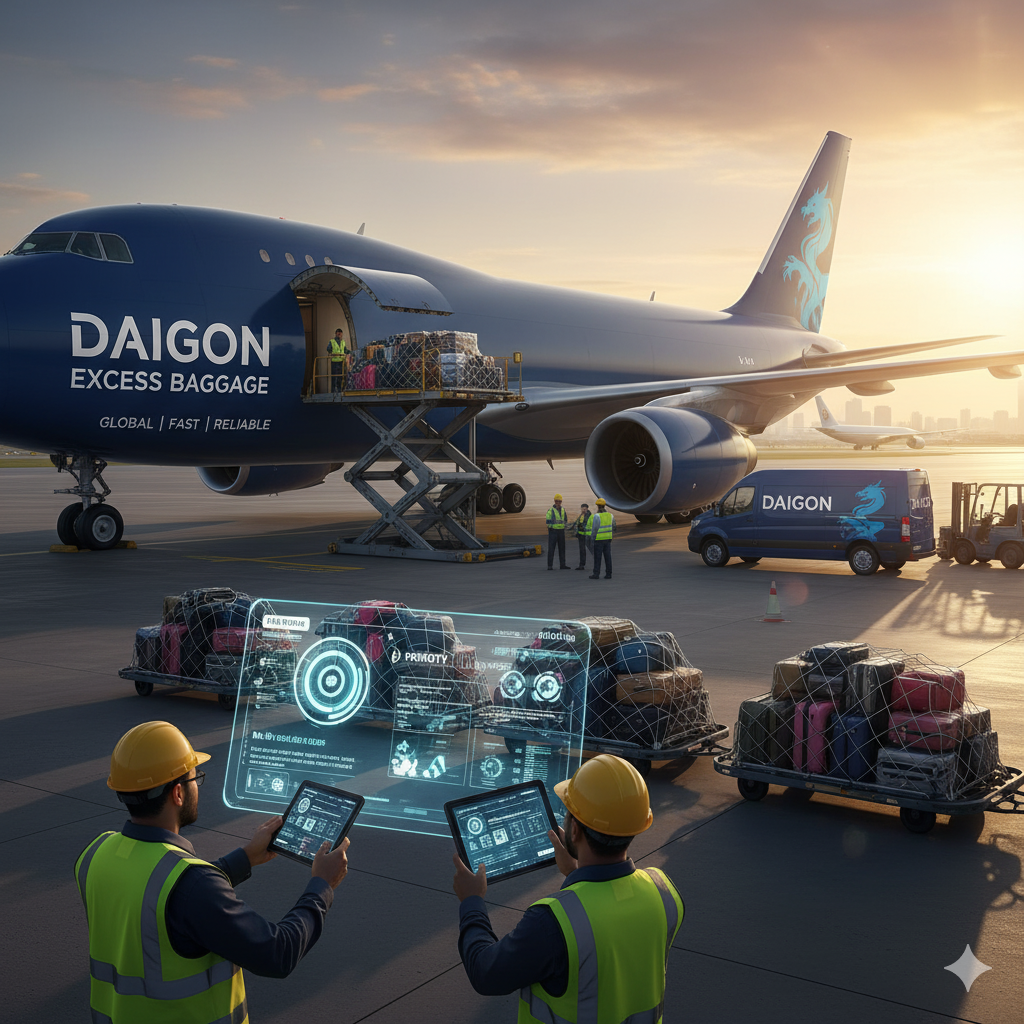
At our hub, your bags are weighed, measured, screened by X-ray (mandatory for air cargo), sealed, and loaded onto specialized Unit Load Devices (ULDs) for the flight.
Your **luggage shipping** begins its journey via our partnered cargo carriers. You track its entire flight path using your unique Daigon AWB number.
Upon landing, your cargo is processed. Daigon’s local agents work with customs to clear your personal effects, minimizing delays and managing necessary duties (if applicable).
Once cleared, the shipment is transferred to our local delivery partner for the final leg, culminating in safe, signed, **door-to-door delivery** at your final international address.
Prohibited and Restricted Items in Excess Baggage Cargo
Due to strict international air transport regulations, not all items allowed in checked luggage are permissible in commercial **air cargo**. It is the sender’s legal responsibility to ensure their **excess baggage** does not contain prohibited materials. Failure to comply can result in fines, shipment delays, or the confiscation of your entire consignment.
Category A: Prohibited Items (Never Ship)
These items pose a direct safety risk to the aircraft, cargo, and personnel. They are strictly forbidden from all **Air Cargo Excess Baggage**:
- Explosives: Fireworks, flares, ammunition, blasting caps.
- Flammable Materials: Paints, thinners, aerosols, lighter fluid, matches, perfumes (with alcohol base), highly concentrated alcohol (over 70%).
- Gases: Compressed air, camping gas, oxygen bottles (unless medical, with prior approval).
- Corrosives: Acids, alkalis, wet cell batteries, drain cleaners.
- Poisons & Infectious Substances: Pesticides, herbicides, biological hazards, medical waste.
- Illegal Items: Narcotics, counterfeit goods, or any item prohibited by the law of the origin, transit, or destination country.
Category B: Restricted Items (Ship with Caution and Approval)
These items require special packaging, documentation, or prior approval before we can include them in your **international luggage shipping**:
- Lithium Batteries: Batteries must be contained *within* the device (laptops, cameras). Loose or spare batteries are usually prohibited in cargo, or restricted to minimal quantities (less than 100Wh).
- Liquids & Creams: Must be securely contained in waterproof packaging (e.g., zip-lock bags inside a sturdy container) to prevent leaks, which can damage other cargo.
- Perishables: Food, plants, and seeds are often heavily restricted or prohibited due to quarantine and phytosanitary rules; check with us first.
- Alcohol: Shipping alcohol is highly regulated, often requiring special licenses and incurring high excise duties. We recommend avoiding shipping large quantities.
Daigon’s Essential Packaging Guide for Safe Luggage Shipping
The success of your **Air Cargo Excess Baggage** relies significantly on the quality of your packaging. Cargo is handled differently than passenger luggage, often moved on pallets and through automated systems. We strongly recommend using **heavy-duty, double-walled boxes** over soft duffel bags for optimal protection and stackability in the cargo hold.
Best Practices for Preparing Your Cargo Consignment
- Remove Old Labels: Before sealing, remove all old airline stickers, customs declarations, and baggage tags to prevent misrouting.
- The “Shake Test”: Pack tightly. If you shake the box or suitcase and hear items moving, you need more cushioning. Use bubble wrap, crumpled paper, or clothing to fill all voids.
- Seal Securely: Use heavy-duty, clear packing tape (not masking tape or duct tape). Seal all seams, including the center seam, and use a technique known as the “H-tape method” to secure all openings.
- Clear Labeling: Affix at least two copies of the Daigon AWB label to the top and side of each piece. Also, include an internal label with your name, phone, and destination address inside the luggage, just in case the exterior label is damaged.
- Protect Fragile Items: For items like glassware or ceramics, wrap individually and pack them in the center of the box, away from all exterior sides, surrounded by at least two inches of cushioning material.
Optimizing for Volumetric Weight
In **Air Cargo Excess Baggage**, costs are often based on volumetric weight (Vol Weight), which reflects density. Vol Weight is calculated as $(\text{Length} \times \text{Width} \times \text{Height}) / \text{Conversion Factor}$. If your actual weight is significantly lower than the Vol Weight, you pay for the space, not the kilograms. **The optimization tip:** Use compact, square, or rectangular containers (like sturdy cardboard boxes) that minimize wasted space. Avoid irregularly shaped or excessively puffy bags, as they will be measured at their largest points, increasing the Vol Weight and, consequently, the final cost of your **luggage shipping**.
Ready to move beyond the limitations of airline baggage policies? Choose Daigon’s efficient and secure Air Cargo Excess Baggage solutions.